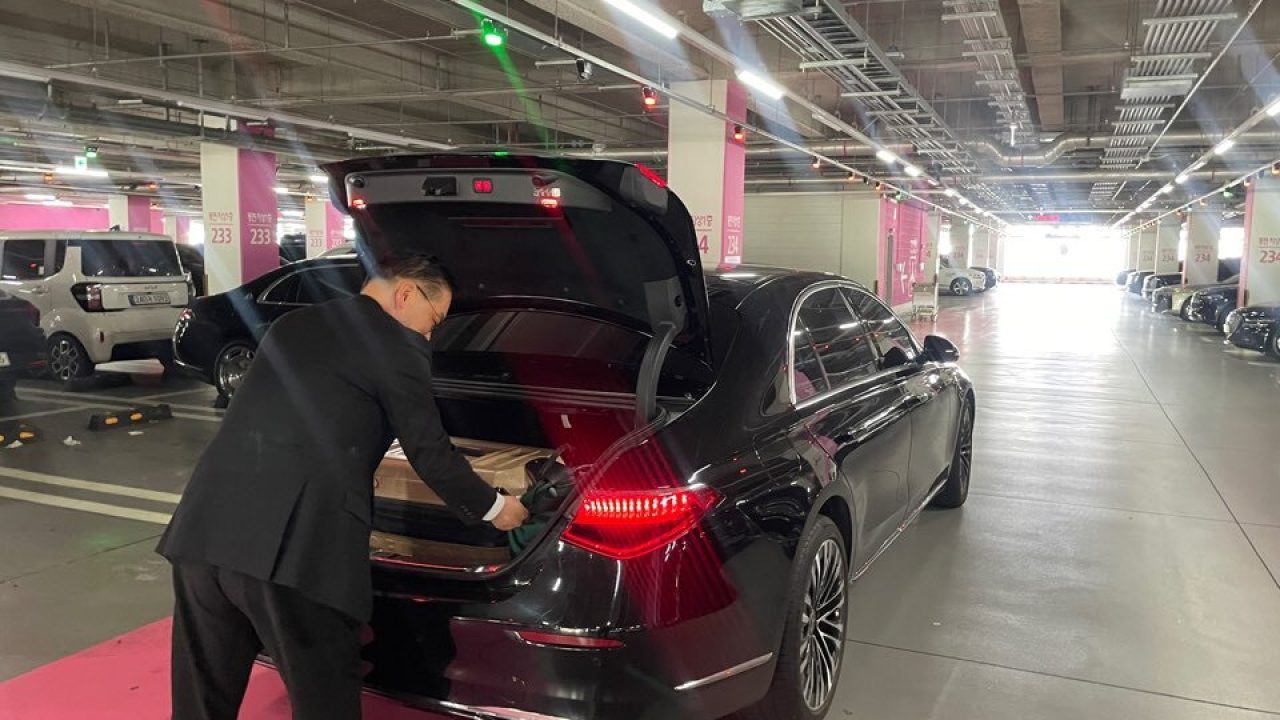
GroundK handled all ground transportation for 40 global sellers from 9 countries over 9 days at X THE LEAGUE Awards, the world's first global commerce league. A total of 19 dispatches, 28 waypoints, 3 vehicle types, and 2 partner operators were coordinated through a single T-RiseUp PMS dashboard.
What was X THE LEAGUE?
X THE LEAGUE is a global commerce competition co-produced by Larastation and ENA. Forty sellers selected from nine countries, including Korea, the United States, Japan, China, Thailand, Indonesia, Vietnam, Singapore, and Malaysia, competed in eight teams, with the winning team taking home $500,000 (approximately KRW 700 million) and the title of Global No.1 Seller.
The awards ceremony took place on July 30, 2026, at 6 p.m. at COEX Auditorium, with the broadcast airing on ENA on August 2. BamBam and Tiffany Young hosted, with performances by FIFTY FIFTY and EPEX. GroundK's scope of operations was not limited to awards day. It covered the full nine days from July 28, when overseas sellers began arriving, through August 5, the final departure date.
Nine countries in one event means nine separate routing projects
Most events divide vehicles by tier: VIP, general, staff. XTL Awards worked differently. The national-team format defined the entire dispatch structure. Each country team had its own headcount, accommodation, interpreter assignment, and arrival and departure schedule, so vehicles had to be allocated on a per-team basis.
Sellers were split across two hotels: Sofitel Ambassador Seoul (Jamsil) and Pullman Ambassador Seoul Eastpole (Gwangjin). The two properties had different locations and different team assignments. On July 29, when the first VIP arrivals landed, Vehicle 1 routed to Sofitel while Vehicle 2 broke off to Pullman.
T-RiseUp PMS was configured to treat this as a single event while still tracking each team's vehicle position and status individually. Partner operators Swiss Tourism (14 dispatches) and AirDrive (5 dispatches) handled separate runs, but everything was visible on one screen.
Eight vehicles rolling out simultaneously at 5 a.m. on shoot day
The operational peak came on July 30, the day of filming. Eight dispatches went out that single day, accounting for 42% of the total 19 across the entire engagement.
Vehicles staged out of both Sofitel and Pullman from 5 a.m. onward, with departure times staggered in 30-minute intervals to reduce congestion at hotel lobbies and the production venue entrance.
05:00 departure from Sofitel: SGMY (Singapore and Malaysia) large bus, Vietnam premium bus, China premium bus
05:00 departure from Pullman: Thailand premium bus, JAPAN premium bus
05:30 departure from Sofitel: Indonesia 02 minibus
06:00 departure from Sofitel: Indonesia large bus, Indonesia 01 minibus
The Indonesia team required a separate configuration because of their larger group size and different schedule: one large bus supplemented by two minibuses. Every vehicle followed a circular routing, departing from each team's hotel, stopping at two waypoints, and returning to the same hotel.
Three airports, departures spread across eight days
Post-ceremony logistics were more demanding than the event itself. The nine country teams did not depart together. On July 31 alone, vehicles had to be dispatched individually to Gimpo International Airport (international terminal), Incheon Airport Terminal 1, and Incheon Airport Terminal 2, with staggered departures continuing through August 1, 2, 4, and 5.
Of the 19 total dispatches, 8 were one-way transfers. Each had to be matched separately to an individual flight and routed from the relevant hotel, with no two sharing the same departure conditions. The overall shape was less like a single event and more like a 9-day transportation project.
This is a recurring challenge in mega-event transfers: arrivals cluster together, departures scatter. Tracking each dispatch individually and keeping on-site chauffeurs aligned with operations requires a shared information layer. All 28 waypoints were recorded in the dispatch data, giving chauffeurs and the operations center the same live view.
Vehicle design by group: sellers, production crew, and staff each had different requirements
The movement groups at XTL Awards were not homogeneous. There were five distinct categories: initial VIP arrivals, national-team seller groups, the larger Indonesia contingent, individual departures on separate flights, and production and staff leaving after the shoot wrapped. Each had different handling requirements.
For small VIP arrivals, 8-seat minibuses and premium coaches were used to raise the level of personal attention. For national teams, vehicles were assigned on a one-to-one basis to preserve each team's identity. For the production crew departure, one-way minibuses and premium coaches were dispatched separately from accommodations in Yeouido and Yeongdeungpo.
The fleet comprised 12 premium coaches, 5 minibuses, and 2 large buses across 3 vehicle types, with a combined seating capacity of 114 seats.
What this operation demonstrated
XTL Awards was an atypical event. The national-team competition format shaped every dispatch decision, and the operation involved two hotel bases, three airports, and five distinct movement groups. It was not a standard vehicle dispatch but a 9-day project requiring 19 uniquely configured transfers executed in sequence.
GroundK has handled comparable complexity before. At the 2026 Mid-Season Invitational (MSI 2026), the team managed arrivals from more than 4 countries, 4 simultaneous flight arrivals, 17 one-way transfers, and 14 daily charters through a single T-RiseUp PMS interface. XTL Awards built on that foundation, adding the complexity of per-team vehicle separation specific to content production events and the management of dispersed multi-day departures.