
GroundK served as the ground transportation operator for the 2026 ITS World Congress (Intelligent Transport Systems World Congress) in Gangneung, taking responsibility for fleet dispatch and safety management across 178 buses, a unified operations control room, a participant Destination Portal, an on-site boarding count system, and ministerial-level VIP vehicle handling. Over the seven-day transport period, 1,055 runs and 6,765 passenger boardings were tracked from a single control room.
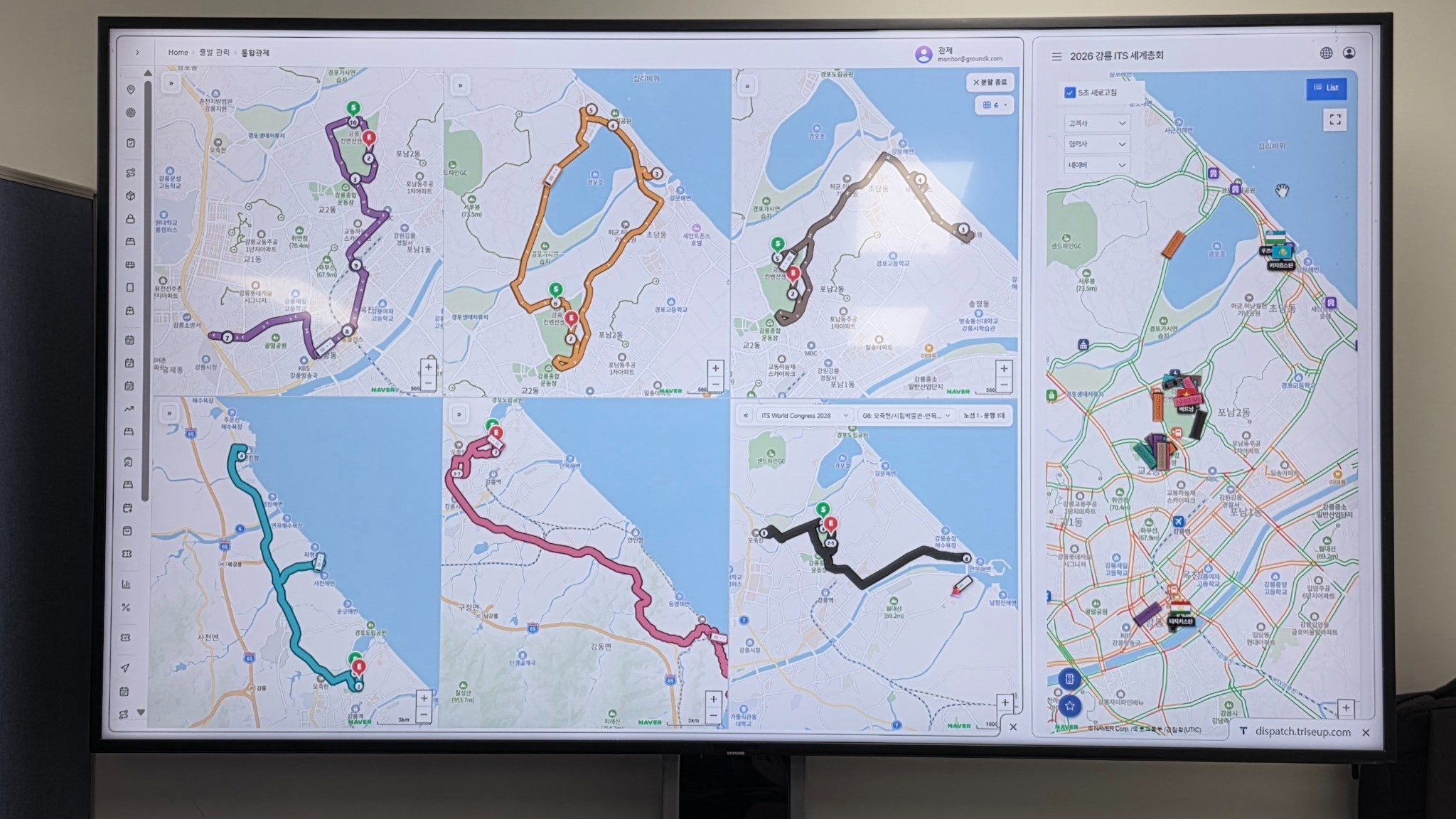
How 178 buses and ministerial vehicles were managed from one screen
The transport control room was set up near the congress operations office at the Gangneung Convention Center. A team of seven worked in shifts from 08:00 to 22:00 each day between October 17 and 23. A large display showed the real-time position of every bus in the fleet, and ministerial VIP vehicle movements were tracked on the same screen in the same room.
The monitoring setup was split by service type. Gangneung city circular routes (G1-G6, OP) were managed through the fleet dispatch management system (TMS), while airport arrival shuttles (IG, GG) were registered and tracked via T-RiseUp PMS. Both feeds fed into the same control room.
Airport shuttles carried an on-board attendant who reported headcounts and timestamps at each checkpoint: departure, rest stop departure, Gangneung toll gate passage, and arrival at hotels or Gangneung Station. This allowed the control room to respond immediately to delays or irregularities.
Contingency procedures were also standardized. If a vehicle became unavailable, the team first checked whether a following vehicle had spare capacity; if not, a reserve vehicle was deployed. In the event of an accident, response followed a four-step protocol: initial response, situation report, insurance handling, and replacement vehicle dispatch. Chauffers were assigned to fixed routes throughout the event to maintain route familiarity, a condition written into contracts with partner operators.
How 15 routes and transport categories were structured
The transport program covered 15 routes and service categories: airport arrival shuttles from Incheon and Gimpo, city circular shuttles within Gangneung, departure shuttles to Seoul after the event closed, and VIP transfers for ministerial delegations, a gala dinner, and technical site visits.
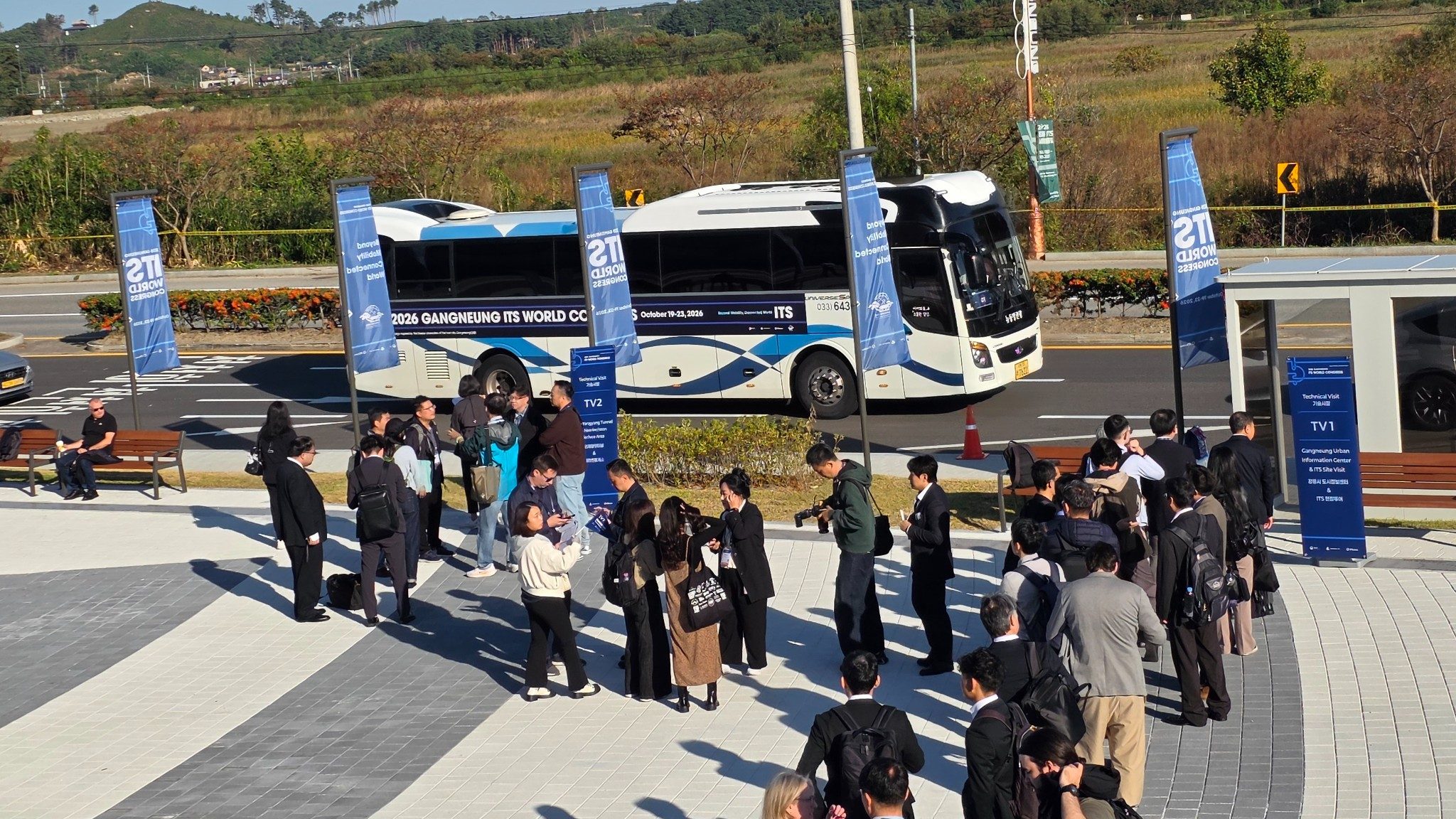
Arrival shuttles ran from Incheon Airport (T2 and T1) and Gimpo Airport. The Incheon service stopped at Munmak rest area en route to Gangneung hotels and Gangneung Station, taking approximately 3 hours 50 minutes; the Gimpo service took around 3 hours 20 minutes. Twelve reserve vehicles were held on standby for group arrivals of 20 or more. Over the three-day arrival window (October 17-19), 299 passengers arrived via Incheon shuttles and 68 via Gimpo, totaling 367.
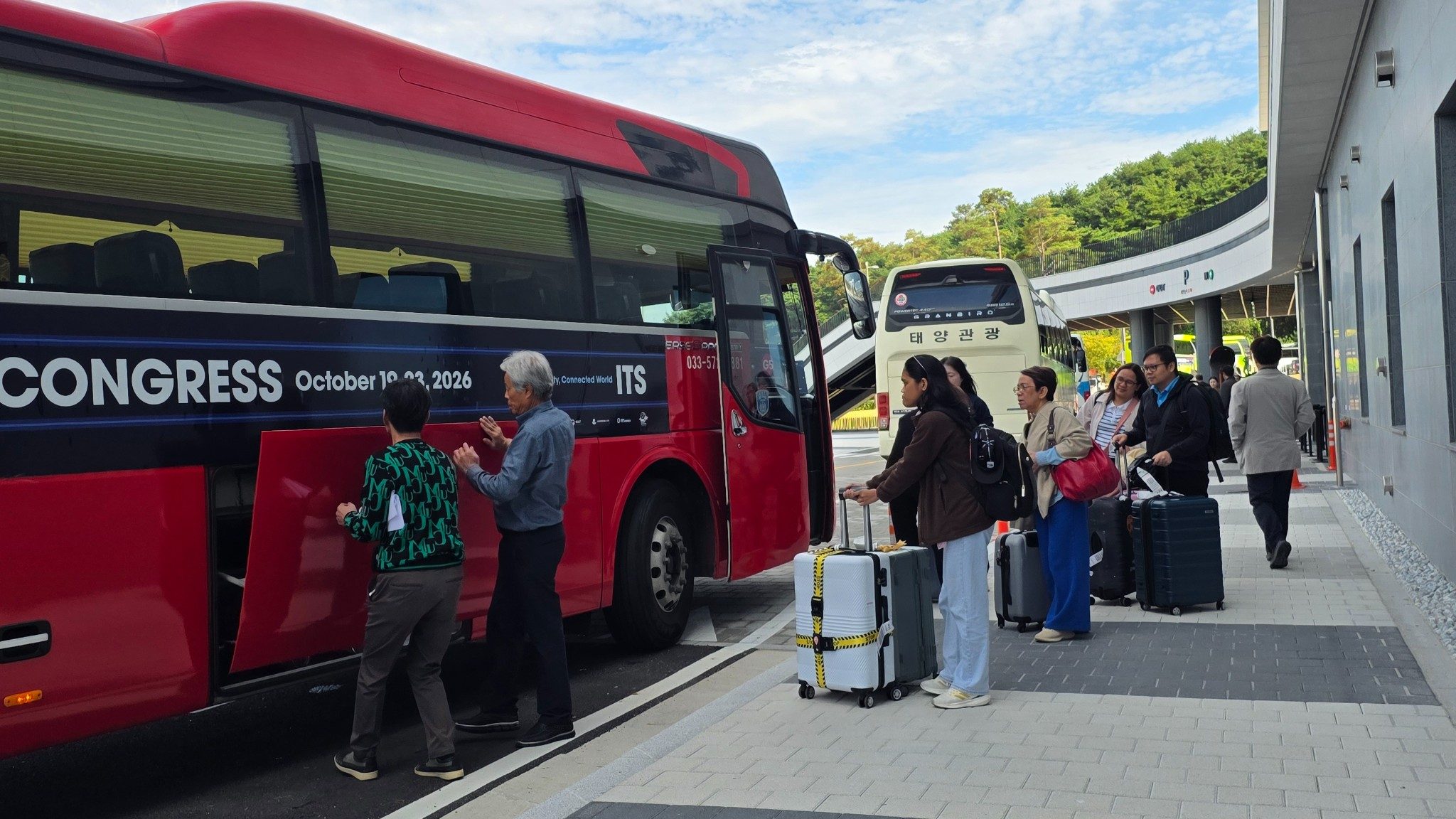
City circular shuttles were organized by accommodation zone. Four residential zones had dedicated routes: Gangmun (G3), Gyeongpo (G2), Jumunjin (G4), and Jeongdongjin (G5). G1 linked Gangneung Station and the express bus terminal, G6 connected tourist sites at Ojukheon and Anmok Coffee Street, and the Olympic Park circular (OP) served the congress venue itself. Circular routes opened in phases from October 18, with all nine running by October 19, the first day of the main congress program.
On days with evening special events, service plans were adjusted. For the drone show, gala dinner, and ice show (October 19, 21, and 22), last departures on G1-G5 were extended to 21:00 and headways were reduced to 15 minutes.
How the Destination Portal turned registration data into dispatch decisions
GroundK built a transport portal where participants could check travel information and book airport shuttles directly. The organizing committee directed participants to the portal as the official transport channel; it ran in both Korean and English.
The portal's core function was a flight-linked demand survey. Participants entered their arrival date and flight number; the system queried the flight to auto-fill the departure airport, arrival airport, and landing time. That registration data was aggregated to determine fleet size, and the confirmed schedule was published back through the portal. Dispatching from actual demand rather than estimates reduced empty runs on airport services.
Route maps and timetables were designed to redraw automatically when route data was updated. Circular shuttle routes changed several times during the preparation period, and this architecture let the team push revisions quickly. Airport welcome desk locations and boarding points were illustrated with floor plans and photographs, and Olympic Park stop coordinates were taken from GPS measurements made on-site.
Beyond airport shuttle booking, the portal also provided city circular shuttle information, a link to KTX ticket reservations, and directions to the venue. Submitted registrations were viewable in an admin panel and downloadable as CSV files for dispatch planning.
How boarding data was recorded run by run
On the ground, staff logged boarding counts directly into a mobile web app. For each entry, they selected the route, boarding point, and run number, then recorded how many passengers boarded and alighted at every stop. Airport shuttle entries also captured drop-off locations and on-board attendant and vehicle details by run. In areas with no mobile signal, data was stored locally on the device and synced when connectivity returned, keeping gaps in the record to a minimum.
The operations dashboard at HQ aggregated the same data by route, run, stop, and time slot. Runs with zero boardings and runs not yet reported were stored as separate states, and an edit history was kept for each run. After operations closed, the accumulated data fed into analyses covering ridership by route, daily trends, peak times on airport shuttles, utilization by accommodation zone, and boarding rates relative to dispatch capacity.
What the boarding data showed
Across 1,055 runs over seven days, 6,765 boardings were recorded. City circular shuttles within Gangneung accounted for 6,398 of those (95%). In-city movement between hotels and the congress venue far exceeded airport arrival demand (367 passengers).
Demand varied significantly by accommodation zone. The Gangmun zone (G3) recorded the highest ridership at 2,262 passengers, followed by Gyeongpo (G2) at 1,666. Together the two zones accounted for 61% of all circular boardings. Of the 11 runs that reached full capacity on a 45-seat coach, 9 were on the Gangmun route. The busiest single run was the 17:30 Gangmun departure on opening day (October 19), which carried 48 passengers.
Two clear demand peaks appeared by time of day: 1,528 passengers (23%) between 08:00 and 09:00, and 2,125 passengers (31%) between 16:00 and 18:00. The evening return wave was notably larger than the morning outbound. The 258 boardings recorded in the 20:00 hour came from the extended last services on days with the drone show, gala dinner, and ice show.
Gangneung Station functioned as more than a waypoint. On the G1 circular, 474 passengers boarded at Gangneung Station while 644 alighted there, with departures outnumbering arrivals. Among the 68 Gimpo shuttle passengers, 32 (47%) also alighted at Gangneung Station, suggesting a substantial share of attendees used KTX for part of their journey.
Because boarding and alighting counts were captured at the stop level, the data can support direct comparisons of demand by individual stop and inform capacity decisions at a future event of similar scale. St. John's Hotel (G3) recorded 805 boardings, the highest of any single stop.
Ministerial VIP handling and other operational scope
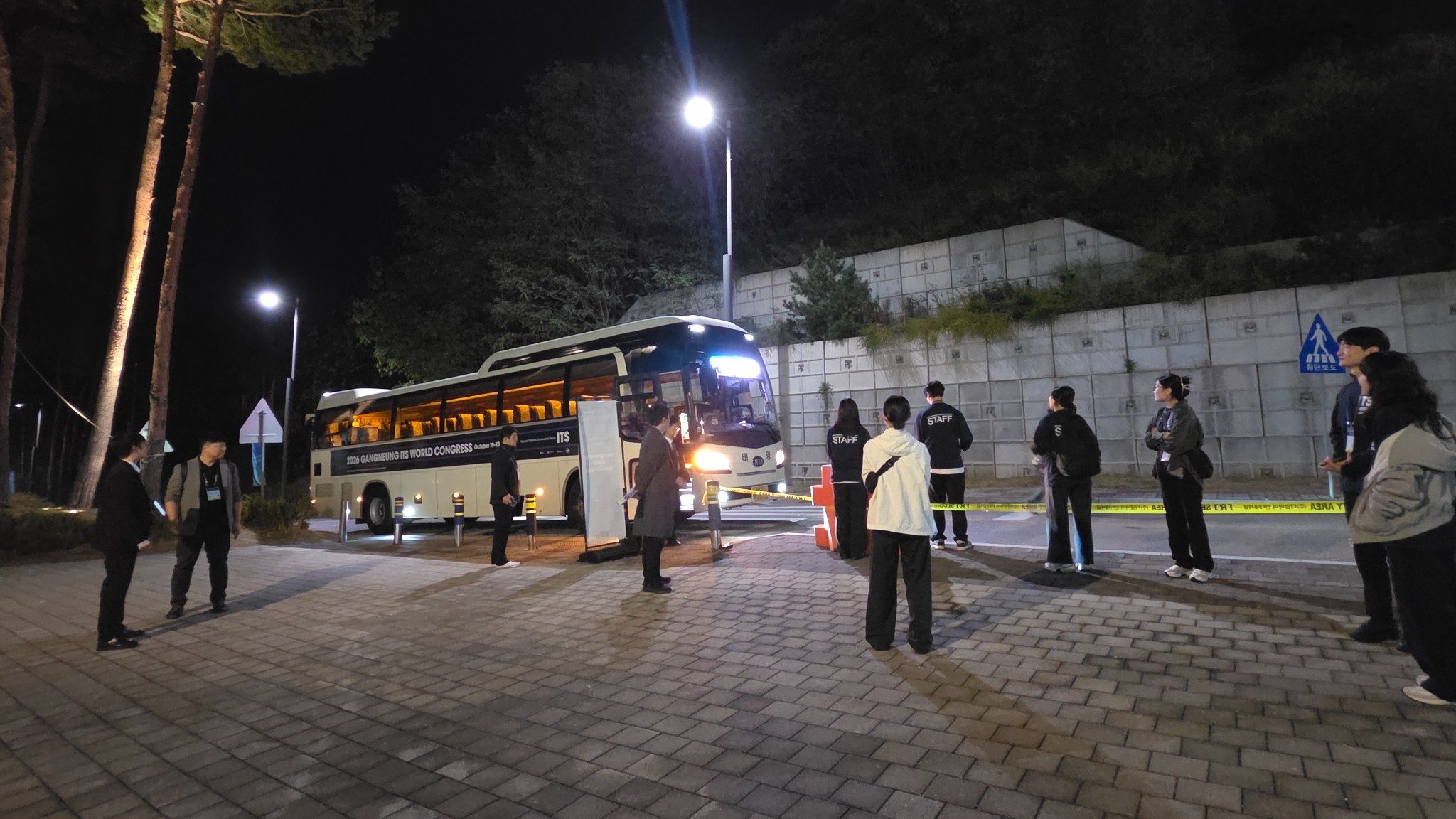
GroundK also handled protocol transfers for ministerial delegations from 13 countries. On the opening ceremony day, ministers traveled by dedicated coach from their hotels to the ceremony venue, with a separate coach for aides and protocol staff; VIP vehicles followed and held in a reserved area. Additional vehicles were kept on standby for latecomers or individuals who needed to leave the group. Ministers' baggage was tagged separately and transported to their hotels by a dedicated vehicle.
Welcome desks operated at Incheon Airport T1 and T2 and at Gimpo Airport's international terminal. The Incheon desks ran from 06:00 to 20:00 and the Gimpo desk from 10:00 to 21:00, each staffed by five people working two shifts. Participants were verified at check-in and then handed over to on-board attendants.
Total operational staffing came to 208 people: 122 on-board attendants for airport arrival shuttles, 22 for city circular shuttles, 5 for the Seoul Station shuttle, 9 for the VIP dinner, 7 in the control room, 37 at transport information desks, and 6 at boarding and alighting points.
Dispatch was adjusted in real time against actual demand. If no passengers appeared at a scheduled departure, the slot was held over to the next run for up to two hours; if still no one boarded, the dispatch was cancelled to avoid an empty run.
What this operation confirmed
The clearest finding from this event is that in-city movement during an international congress generates far more demand than airport arrivals. Ninety-five percent of all boardings occurred within Gangneung, and ridership differed sharply between accommodation zones. The data makes a direct case for factoring hotel assignment patterns and zone-to-venue distances into circular shuttle capacity planning from the outset.
The Destination Portal model, where flight registrations are collected before dispatch sizes are confirmed, proved effective at reducing empty airport shuttle runs. The stop-level boarding and alighting records, stored run by run, are directly usable as a baseline for capacity decisions at a comparable future event.