
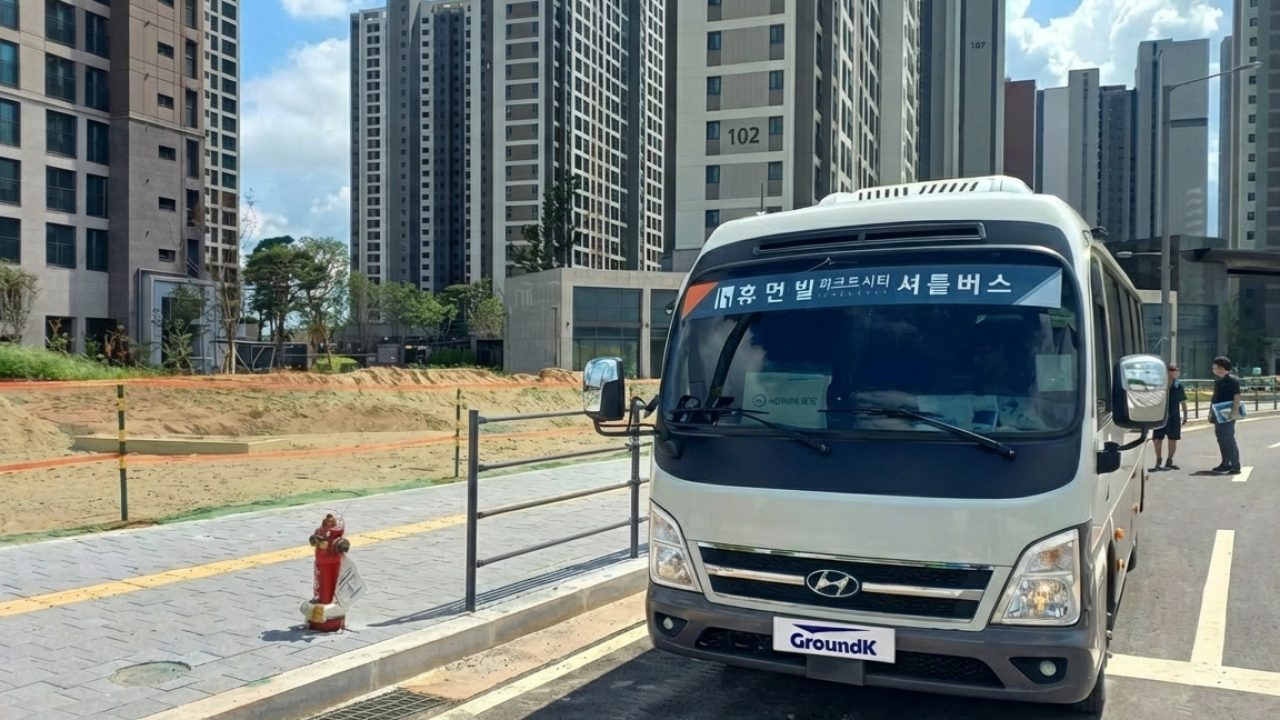
RIDEUS ran a residents-only shuttle for Pyeongtaek Hwayang Humanvill First City, the first complex to begin occupancy in the Hwayang district. With a system-led operation that did not rely on on-site staffing, and a web-based shuttle that needed no app, RIDEUS resolved the early-occupancy mobility gap before public transit had arrived.
A mobility gap in the earliest days of occupancy
In newly developed areas such as the Hwayang district, the early stage of occupancy carries a particular challenge: until city buses and everyday infrastructure are in place, any difficulty in getting around feeds directly into how residents feel about their new home. Pyeongtaek Hwayang Humanvill First City was the first complex in the district to open its doors, so the question of how to support residents' daily travel before the transit network arrived became a defining one.
Early-occupancy travel friction was never only about movement. It shaped settlement conditions and day-to-day satisfaction. Commutes, school runs, and grocery trips all collide with a thin transit network, and resident frustration builds quickly when they do. Recognizing this, the developer decided to introduce a residents-only shuttle to give everyday travel a dependable footing from the very first day. The real test was to stand up an operation that ran without wobble from day one, even amid the uncertainty of a site whose infrastructure had not yet arrived.
A system-led answer to the shuttle question
RIDEUS answered with a system-led shuttle model that could run without depending on a field workforce. The goal was to settle a dependable shuttle service from the earliest days of occupancy, without heavy staffing or operational burden.
The starting point was access that anyone could use right away. Our team built a web-based shuttle system that required no separate app, so residents could check schedules and service notices straight from their phones. A clean interface showed only the information riders actually needed, designed so that anyone could use it regardless of age or comfort with technology.
A rider-first service experience
Alongside the system, we refined the service around how people actually use a shuttle. The things residents need most — lost-and-found guidance, schedule changes, urgent alerts, and answers to their questions — were delivered quickly through notices, pop-up urgent announcements, and one-touch customer support. Together these kept friction during everyday use to a minimum.
Routes, dispatch, and operations under one design
The shuttle operation was designed as a single system, from route planning through dispatch and daily run management. By studying residents' travel patterns and demand across the day, RIDEUS shaped efficient routes and managed dispatch and operations through the web system, cutting unnecessary trips and waiting time even in the early occupancy period. Because route planning, dispatch, and run management lived inside one system rather than running apart, adjusting the operation as demand shifted was far simpler. The result was a stable operation that held a consistent level of service quality throughout.
A model proven even in an early-stage development area
This project shows that even in a development area where the transit network is not yet complete, a residents-only shuttle can be settled and run reliably on a web-based system, an easy interface, and a system-led operation alone. Three things carried it. First, web-based access that removed the barrier of installing an app. Second, a rider-first response that bundled lost-and-found guidance, schedule changes, urgent alerts, and inquiries into notices, pop-up announcements, and one-touch support. Third, an operation design that brought route planning, dispatch, and run management into a single system.
With those three working together, a consistent level of service held from the first day of occupancy without leaning heavily on on-site staff. The same approach can carry over to other new complexes where public transit is thin at move-in, and it serves as a worked example for developers and operators weighing a residents-only shuttle, drawn from our apartment resident shuttle guide. Beyond easing early-occupancy travel friction, it stands as a mobility operation that made a real improvement to settlement conditions.