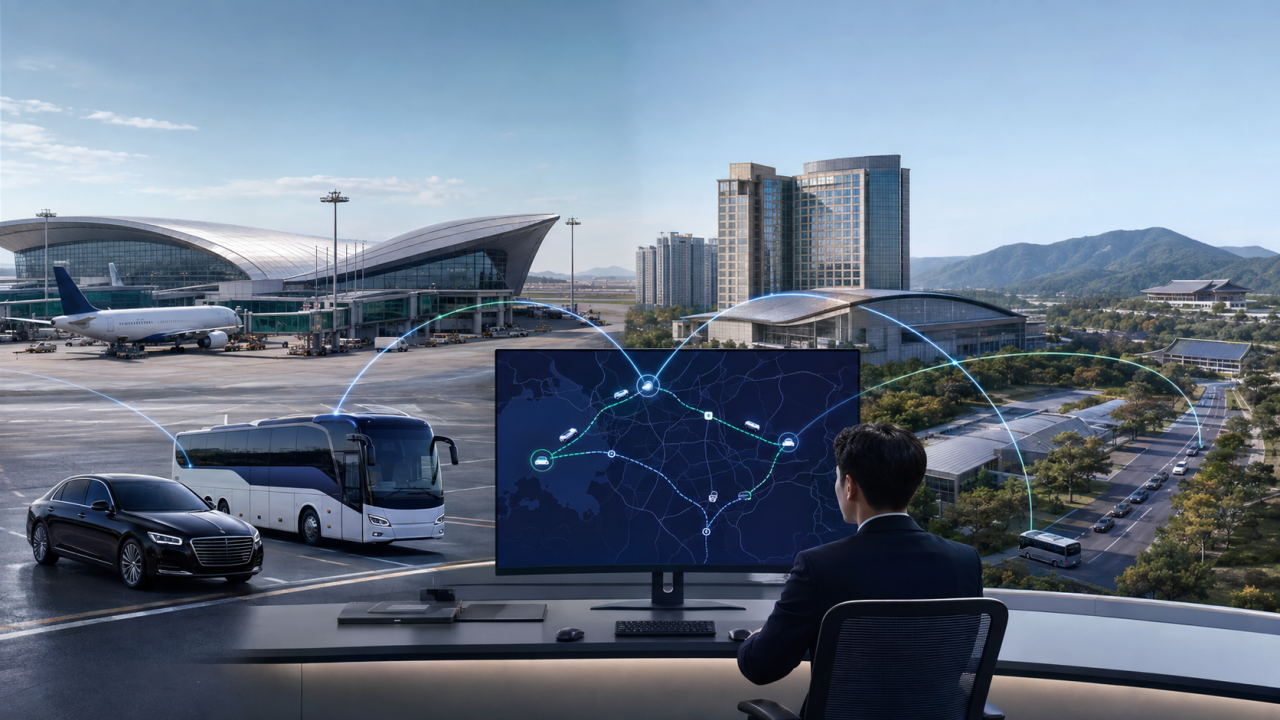
When vehicles at a summit, stadium concert, or corporate event seem to run without a hitch, it is because a back office is quietly coordinating dispatch, billing, and real-time control throughout. That infrastructure is invisible to passengers, but the moment it wavers, hundreds of vehicles stall and thousands of itineraries collapse at once. In mega-event transportation, GroundK integrates all three functions into a single digital framework, and that experience has made clear just how decisively the back office determines whether large-scale group transfers succeed or fail.
What Happens Without a Back Office
Moving ten vehicles is manageable with one experienced chauffeur and a few phone calls. Move to 100, 300, or 500 vehicles and the equation changes entirely. The moment you try to handle manually who rides which vehicle, where each chauffeur currently is, and how billing will be calculated, errors start to compound.
Looking back at large events GroundK has operated, past cases that lacked a structured back office consistently show the same three failure points: vehicle assignment confusion caused by passenger manifest errors; post-event billing disputes driven by inconsistent rate criteria; and delayed responses during unexpected situations due to gaps in real-time control. These problems do not occur in isolation. When one breaks, the other two follow.
Dispatch: First and Most Precise
Dispatch is where the back office begins. It looks simple from the outside, but complexity scales exponentially as fleet size grows. At a summit-level event with 500 vehicles moving simultaneously, vehicle class, passenger count, routing priority, and arrival intervals all have to be engineered in advance.
GroundK manages VIP vehicle dispatch through T-RiseUp PMS, with passenger data, vehicle class, and chauffeur assignments linked inside the system. That removes the need to cross-reference paper manifests or confirm assignments over radio on-site. At APEC 2025 KOREA, this approach kept vehicle assignment errors at zero across delegations from 21 countries.
Shuttle operations have a different character. Routes repeat, but reservation data shifts in real time and the number of vehicles deployed must adjust to passenger load. T-RiseUp TMS connects live reservation data directly to dispatch, optimizing fleet deployment without manual intervention. At the 2025 SBS Gayo Daejeon on Christmas Day, roughly 4,400 seats across two shuttle routes were managed with zero passengers left behind.
Billing: The Work That Continues After the Event
Billing for large-scale group transportation is more complicated than it appears. Vehicle class rates, operating hours, passenger counts, waiting-time surcharges, and fuel cost variations are all live variables. The larger the event, the more these variables interact and the harder it becomes to maintain clear billing criteria.
Two types of disputes come up repeatedly on-site. The first is a mismatch in trip counts between the chauffeur side and the client, caused by missing operational records. The second is a discrepancy between passengers actually carried and passengers billed, because reservation changes or cancellations were not reflected in time. Both situations get worse when on-site records are not captured digitally.
GroundK designs its operations so that reservation, boarding, and QR scan data all remain in a single system. For the NC Dinos fan shuttle, a T-RiseUp TMS reservation page and QR gate integration gave GroundK live ridership data throughout. That same data feeds directly into post-event billing, reducing the scope for disputes and cutting the time needed to close out accounts.
Control: What the Operations Center Does While the Event Runs
Where dispatch handles pre-event planning and billing handles post-event reconciliation, real-time control holds everything together while the event is actually running. Vehicle locations, route deviations, delays, and chauffeur communications are all monitored from a central transportation control point (C.P.).
At large-scale events, unexpected variables are routine, not exceptions. A VIP schedule gets pulled forward. A road closure blocks a planned route. A chauffeur goes out of contact. None of these stays a single-vehicle problem. A five-minute delay in a chauffeured vehicle's departure can push an entire sequence of engagements, with the effects carrying into the next day.
Effective control requires two things: a system that shows vehicle positions and chauffeur status in real time, and operations center staff who can make decisions the moment a situation develops. At the Korea-Africa Summit with delegations from 48 countries, GroundK maintained control operations throughout and completed every routing segment on schedule. Technology alone cannot do that. It takes systems and people working together.
What Happens When the Three Functions Run Separately
Consider what happens when dispatch, billing, and control each run on separate tools with separate teams. The control team decides to add vehicles on-site, but if that information does not reach the dispatch team in real time, the passenger manifest no longer matches actual operations. When operations diverge from the manifest, the billing basis becomes unreliable too. Without a single data flow connecting all three, errors accumulate as scale increases.
That is exactly where GroundK's solution started. Running hundreds of vehicles directly in VIP and protocol transportation made it possible to see precisely where errors emerge when dispatch, billing, and control are disconnected. T-RiseUp PMS and TMS were built from that operational experience. Having run the events first is what made it clear which points needed to be connected.
How to Assess a Provider's Back-Office Capability
When commissioning large-scale group transportation, a few practical questions can reveal whether a provider's back office is genuinely capable.
Where does dispatch data live? Is it recorded in real time within a system, or on paper manifests and spreadsheets?
Are billing criteria defined in writing before the event? Can operational data feed directly into billing without manual reconciliation?
Is the control function staffed and active throughout the event? Are the operating hours of the control room and the responsible personnel clearly defined?
Do all three functions share a single data flow? When the control team makes a real-time decision, does it automatically update dispatch and billing records?
A provider who can answer these questions in specific terms is one who can deliver events where vehicles simply run without incident. The back office is never visible, but its proof is the quietness of the operation itself.